


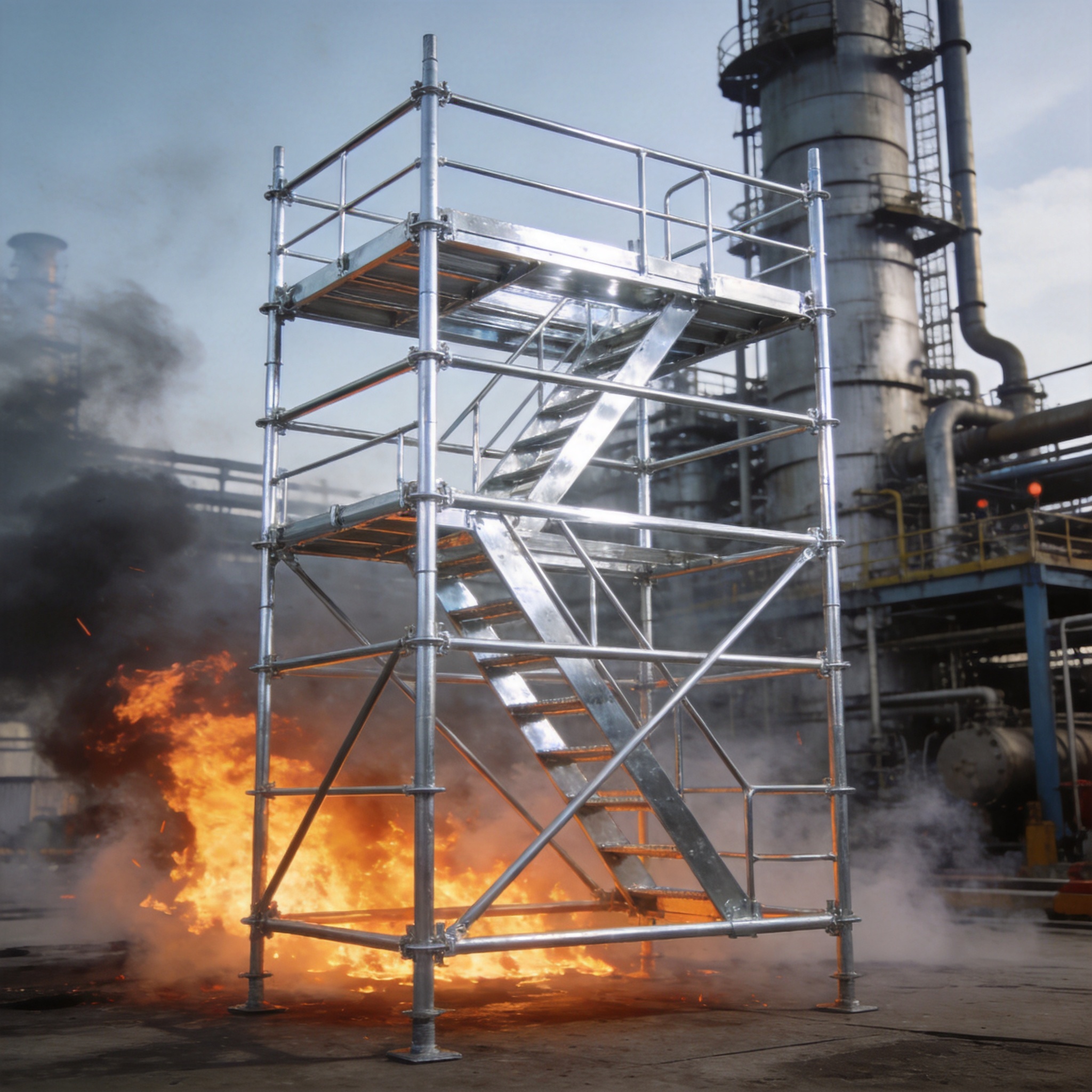


Imagine a world where construction projects rise not just in stature but in time efficiency and safety. This is no longer just a dream but a reality brought to life by industrial scaffolding. Gone are the days when scaffolding was merely a makeshift arrangement of planks and poles. Today, it’s a well-engineered masterpiece that transforms construction sites into hubs of heightened productivity and security. From skyscrapers piercing the sky to bridges spanning great distances, industrial scaffolding is the silent hero, ensuring workers reach new heights with confidence and precision.
Recent statistics reveal a significant reduction in construction site accidents where advanced scaffolding systems are employed. This innovation is not just about reaching higher; it’s about doing so smarter. The advent of modern scaffolding solutions has redefined construction dynamics, ushering in an era where efficiency and safety harmoniously coexist. In our exploration of industrial scaffolding, we’ll uncover how these towering structures are reshaping the landscape of construction. Join us as we delve into the remarkable impact these frameworks have on building not only structures but a safer world.

Evolution of Scaffolding in Construction
The story of scaffolding begins in antiquity, where early builders in Egypt and Greece erected rudimentary wooden frameworks to raise workers and materials. These primitive platforms relied on hand-hewn logs, ropes, and woven mats—tools as basic as the monumental pyramids and temples they helped construct. During the Middle Ages, timber scaffolding evolved alongside cathedral building, with master carpenters crafting complex networks of beams supported by mortise and tenon joints. Yet, despite their ingenuity, these systems lacked standardization and often posed significant hazards due to uneven load distribution and weather-induced deterioration.
The Industrial Revolution paved the way for iron and steel to replace wood, marking the first major shift toward today’s engineered scaffolding. In the 20th century, the introduction of lightweight alloys and modular components heralded a new era. By the late 1900s, manufacturers began offering prefabricated frames, cross-braces, and adjustable jacks, streamlining assembly and disassembly. This transformation gave birth to what we now recognize as industrial scaffolding—highly engineered, tested, and certified for use across diverse construction projects. From historical timber huts to modern scaffold towers, this evolution underscores how innovation in materials and design has consistently elevated both efficiency and safety on job sites.
Enhancing Safety Standards Through Modern Scaffolding Systems
Today’s industrial scaffolding systems are engineered with an unwavering focus on occupational safety. Modular guardrails, toeboards, and non-slip decking are integrated as standard features, drastically reducing fall risks. Components undergo rigorous quality control and load testing, ensuring they meet or exceed international safety standards such as OSHA and EN 12811. Scaffold tags and color-coded indicators quickly communicate inspection status to workers, fostering a culture of vigilance and proactive maintenance.
Beyond physical safeguards, modern scaffolding solutions incorporate digital innovations to fortify safety protocols. Laser scanning and 3D modeling allow site managers to plan scaffold layouts in virtual environments, identifying potential hazards before assembly. Smart sensors embedded in platforms can detect overloading and structural movement, triggering real-time alerts. By combining traditional safety measures with cutting-edge technology, industrial scaffolding systems not only protect personnel but also drive down insurance costs and minimize downtime caused by accidents or compliance infractions.
Increased Efficiency and Productivity on Construction Sites
One of the most transformative benefits of industrial scaffolding is the dramatic reduction in setup and teardown times. Prefabricated frames, quick-connect couplers, and lightweight aluminum planks enable crews to erect multi-level structures in a fraction of the time required for conventional wooden scaffolds. Mobile scaffold towers fitted with swivel casters can be repositioned swiftly, allowing teams to adapt their work zones without dismantling entire sections. This level of agility accelerates project timelines, letting contractors meet tight deadlines without compromising on quality or safety.
Productivity gains extend beyond mere speed. With modular scaffolding, laborers can access elevated work areas more ergonomically, reducing fatigue and improving precision. Features like adjustable platforms and integrated ladders streamline material handling and tool storage at height, minimizing repetitive climbs and descent. Collaborative workflows benefit as scaffold layouts can be tailored to support multiple trades—steelworkers, masons, painters—simultaneously. In essence, industrial scaffolding catalyzes a smoother, more coordinated construction process, driving both output and worker satisfaction.
Customization and Adaptability of Modern Scaffolding Solutions
Every construction site presents unique challenges—from uneven terrain to intricate architectural features. Modern industrial scaffolding addresses this diversity through highly customizable systems. Adjustable base jacks, telescoping standards, and swivel couplers allow for precise leveling on sloped ground, while cantilever brackets extend platforms around obstructions. Scaffold manufacturers offer a range of specialized accessories such as bridge decks, internal stair towers, and debris chutes, enabling teams to tailor configurations to project requirements.
Adaptability also shines in retrofitting and renovation projects, where existing structures demand scaffold solutions that can conform to irregular facades. Lightweight aluminum and composite scaffolding kits can be assembled in confined spaces or hoisted into position by cranes, reducing the need for extensive groundwork. Some systems even feature quick-release pins and folding frames for rapid deployment in emergency maintenance or inspection tasks. By marrying flexibility with robustness, industrial scaffolding empowers contractors to overcome spatial constraints and evolving site conditions without sacrificing stability or safety.
Conclusion: Industrial Scaffolding as the Pillar of Modern Construction Sites
Industrial scaffolding has come a long way from simple wooden platforms to sophisticated, modular systems that redefine construction safety and efficiency. These versatile structures not only accelerate project timelines but also uphold the highest safety standards, thanks to innovative materials and smart technologies.
As the construction industry continues to evolve, industrial scaffolding remains the backbone that supports every ambitious architectural endeavor, ensuring that builders can reach new heights—both literally and figuratively—without compromise.
